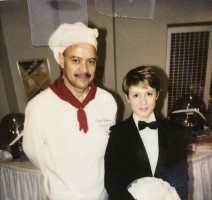
In the early 90s I started working as a cater waiter in New York City. One day I was working a private home job on the Upper West Side with another waiter when the client came rushing into the kitchen to find us. She spoke directly to the other waiter—I’ll call her Pam—who was much taller and naturally blonder than me at the time and said, “Here. Take my credit card, Zabar’s is expecting you,” and promptly left the room. Without any further conversation, Pam turned to me and said,
“Yeah. I don’t go outside in public in my waiter uniform. Here, you take it.”
I took the card and headed for the front door because I was certain that if one of us didn’t do what the client said as soon as possible we’d be fired. On the elevator ride down the gravity of this situation—holding this much available credit in my hand—made my palms sweat, and it felt as if the card had seared a hole through my hand.
The moment I entered Zabar’s, a cashier shouted at me asking if I was here for our client’s order, and when she said her name, people standing in line turned to see who was her waiter. I nodded, and the cashier told me where to stand. I waited in front of the salmon counter for close to 15 minutes while her order was being prepared. Now that the problem had been solved, I had plenty of time to ponder Pam’s reaction, and plot how I would deal with Pam for the rest of the gig. Until this moment, I honestly never thought that much about wearing a uniform in public. In fact most people who passed me on the way to Zabar’s looked up and gave me a little smile. What exactly they were thinking is hard to know for sure, but no one turned their heads to avoid looking at me and no one was shaking their fists at me. When I came back into the kitchen with the order, I decided to confront Pam directly.
“Is there anything else I need to know about your deepest fears before we start this gig?”
Pam’s face turned bright red, and she launched into a long explanation about how her agent would be mortified if someone told her they had seen her in this outfit. I knew it was a lie. But it put her on the defense and she pretty much kept quiet and left me alone for the rest of the night. Years later I wondered many times how she is doing and I hope she found a good therapist so she can leave buildings without her morbid self-consciousness, or what I would say is more about her class anxieties.
My memoir will always be a working class story, something I never deny or try to hide. I was proud to have a uniform because it meant I was gainfully employed. In his book Class Paul Fussell speaks to hierarchical status-ordering in an honest and humorous way. The cashier felt comfortable yelling across the room to me because I had a uniform on, I was working class like her, and she enjoyed reminding me who I was in this world. When I came back to the apartment, the client was on the phone with the store, and I knew the report would be positive. I liked working in private homes, and I kept doing it when I was a graduate student in another state. For the most part the pay was good, and I learned so much about the inner political and financial workings of both cities rather quickly. Besides I had bigger plans. When I left New York City for the first time I left with a BA in English from Hunter College.
There’s a section in Class on what uniforms can tell you about someone’s job, but warns the reader that status panic also comes from “rich people who remain stubbornly middle-class.” Time and time again I return to his book and other books about class in storytelling, which I highly recommend.
 Mary Louise Penaz
Leave a comment