I worked at the Bookstop in Houston for a year before I started graduate school. My husband was a full-time CWP student and Comp Teacher at the University of Houston at the time. Nothing made me happier than helping customers find books they were looking for. In those days there were two data machines to access information and I quickly figured out how to find pretty much every book title in the world.
For this reason, my boss loved to keep me posted behind this triangle shaped counter and soon I had a pretty good following. The door would swing open and a customer would run straight to my counter:
“I think I need a book titled, When the Dogs Bark.”
“Do you mean “When does the Cat Meow” ? I’d respond and she’d smile.
“Aisle 7 Shelf A.”
It turns out that most customers can’t stop at one book. Nothing made me happier than offering advice on what books a customer might like. It was pure heaven wandering the store with a customer talking nonstop dropping authors names and new titles and old titles. I offered to reorganize the poetry section and started ordering missing titles. I made a shelf specifically to showcase UH authors. I learned so much about the publishing industry. And I worked with a wonderful woman who had a photographic memory.
“Who is the author of ……..” I’d shout out, and she’d yell back the name from somewhere in the store.
She told me she could summarize an entire trilogy if I needed her to. (But I never asked).
The employee discount worked wonders. When we arrived in Houston from New York City we had half a medium size moving truck full of boxes of books. When we drove back to New York City from Houston years later we had twice as many boxes of books. Which brings me to the subject of this blog post.
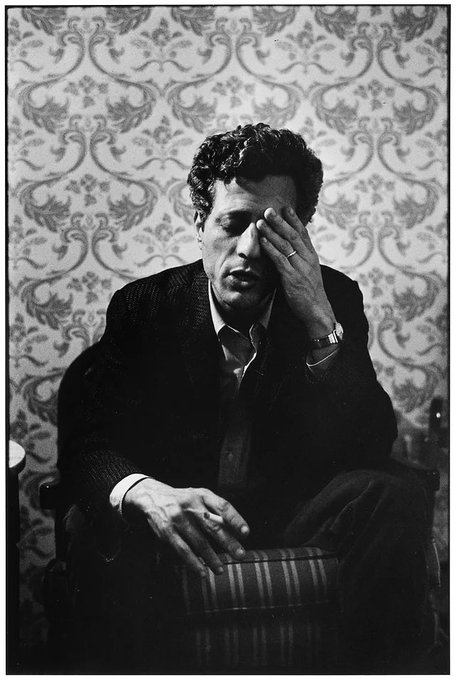
The poetry of Bert Meyers came to me like so many other books of poetry have come to me over the years: I read about him when another poet, Dana Levin, discussed his work online. I have impossibly high standards when it comes to poetry, and I was surprised but delighted to find Bert, who unbeknownst to me was posted on the Poetry Foundation web long before I found him.
Today my big art question is this: Why aren’t there more books laid out like this one?
Because this book is laid out differently. There’s an intro, personal photos, letters written by the author, essays written by other writers on the poet, brilliant ideas about how his Jewish identity is part of his artistry, and of course his dark, difficult, joyous, sublime, exquisite poetry like this:
Be like the rain
That wears the ragged coat
and finds a lamp
in the smallest stone
and sings for nothing
from street to street.
1979
It took hours for me to decide which poem to post, so please, buy this book and read all of them.
Over the years I saw a couple contests asking for hybrid submissions, and I am hoping that writers will study a poet of this magnitude and others in this same way.
But I’m also wondering about the endless possibilities of more new books written deliberately in this way. I hope that young writers take a look at this book. I hope that every CWP and Literature Program stocks this book in the library.
 Mary Louise Penaz
Leave a comment